

It’s one of those Sunday afternoons. You’ve got a mountain of laundry, the kids’ soccer uniforms are wet, and you’ve just realized the dryer has been running for two hours and the clothes are still damp. You clean the lint trap (as you always do), but nothing changes.
When this happens, most homeowners start searching for a reliable dryer vent cleaning company near me to solve the mystery. If your dryer exhausts through the roof rather than a side wall, you are likely dealing with a classic case of vertical congestion. At MMI Home Improvement Pro, we’ve seen everything from “lint-bergs” to birds’ nests clogging up these systems. While wall vents are prone to buildup, roof vents are in a league of their own when it comes to getting blocked quickly.
5 Key Reasons Your Roof Dryer Vents Clog So Fast
1. The Physics of Gravity vs. Airflow
The most fundamental reason roof dryer vents clog faster than wall vents is simple physics: Gravity.
When your dryer is running, it’s fighting an uphill battle, literally. It has to push hot, moist air and heavy, wet lint up a vertical column that may be 10, 15, or even 20 feet high.
- The “Fall Back” Effect: In a horizontal wall vent, lint travels along a flat path. Even if the airflow isn’t perfect, the lint tends to drift toward the exit. In a roof vent, the moment the dryer cycle ends and the airflow stops, any lint that hasn’t quite made it out of the roof cap falls back down the duct.
- Accumulation at the Base: Over time, this “falling” lint accumulates at the bottom of the vertical run, usually near the transition duct behind your dryer. This creates a bottleneck that restricts airflow, making it even harder for the next load’s lint to make the climb.
Read Also: Benefits of Hiring a Professional for Dryer Vent Cleaning Service
2. Condensation: The “Glue” of the Duct World
Dryers don’t just exhaust lint; they exhaust gallons of water in the form of steam. In a wall vent, this moisture has a relatively short, direct path to the outside. In a roof dryer vent, the journey is longer and colder.
As the hot, moist air rises through a vertical duct (especially one passing through an uninsulated attic), it begins to cool. When that air hits the dew point, it condenses back into liquid water on the inner walls of the duct.
The Result? You now have wet duct walls. When dry lint passes through, it sticks to these damp surfaces like glue. This “lint paste” hardens as it dries, creating a restrictive layer that catches even more lint. Before you know it, a 4-inch duct has been narrowed down to 2 inches of breathing room.
3. The Design of the Roof Cap
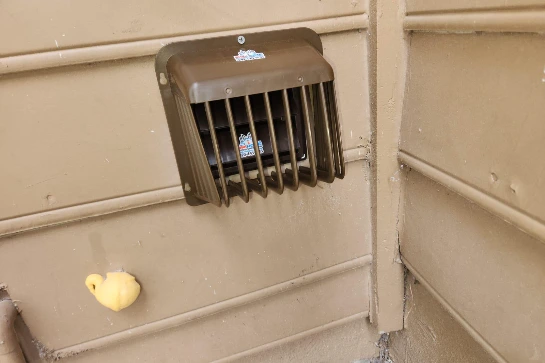
The exit point of your ventilation system is the “gatekeeper” of airflow. Wall vents usually feature simple flaps or “lamb’s beak” hoods that open easily with a puff of air. Roof vents, however, require more complex hardware to remain weather-proof.
The Screen Trap
Many roof caps come equipped with a fine mesh screen designed to keep rodents out. While this sounds like a good idea, it is the mortal enemy of a dryer. Lint is fibrous and loves to hook onto wire mesh. Within just a few months, a screened roof vent can be 90% blocked by a “lint mat” that prevents any air from escaping.
The Damper Weight
Roof vents often have weighted dampers to prevent rain and gravity from keeping them open. Because these dampers face upward or are tucked under a heavy shroud, the dryer has to work significantly harder to blow them open compared to a lightweight plastic flap on a side wall.
Read Also: Common Roof Dryer Vent Problems and How to Fix Them
4. Environmental Factors: The “Bird’s Eye” View
Your roof is a high-traffic area for nature. While a wall vent is accessible to the occasional squirrel, a roof dryer vent is a prime piece of real estate for birds, particularly starlings and sparrows.
- Warmth in the Winter: Birds love the heat rising from your dryer. It’s the perfect spot to build a nest.
- The Vertical “Basket”: Because the vent goes straight down, it acts like a structural support for nesting materials. A bird can drop twigs and straw into a roof vent, and they will lodge perfectly in the duct, creating a platform for a nest that completely seals the vent.
- Snow and Ice: If you live in a colder climate, snow accumulation on the roof can physically bury the vent. Even if the heat from the dryer melts some of it, the resulting meltwater can refreeze into an “ice dam” over the vent opening.
5. “Out of Sight, Out of Mind”
This is perhaps the most common reason for severe blockages. If your dryer vents through a side wall, you probably see the vent every time you take out the trash or mow the lawn. You can see the lint hanging out, and you know it’s time to clean it.
Roof dryer vents are invisible to the average homeowner. Unless you’re comfortable climbing a ladder and walking on your shingles, you have no idea what’s happening up there. At MMI, we find that roof-vented systems are cleaned 50% less often than wall-vented systems simply because homeowners forget they exist.
The Comparison: Roof Vents vs. Wall Vents
Feature Wall Vent Roof Vent
Gravity Resistance Low (Horizontal flow) High (Vertical climb)
Condensation Risk Moderate High (Longer attic runs)
Pest Accessibility Medium (Rodents) High (Birds)
Ease of Inspection Easy (Visual from ground) Difficult (Requires roof access)
Blockage Speed Slow Fast
Signs Your Roof Dryer Vents Need Cleaning
If you haven’t had your roof vent checked in the last year, look for these “Red Flag” symptoms:
- The “Double Dry”: You have to run the dryer for two or more cycles to get a single load dry.
- Hot to the Touch: The top of the dryer or the clothes themselves feel scorching hot at the end of a cycle.
- The “Musty” Smell: Your clothes or the laundry room smell damp and earthy.
- No Flap Movement: When the dryer is on, you don’t see any air movement or “fluttering” from the roof cap (if you’re brave enough to look from the ground with binoculars!).
Summary
Your roof dryer vent is the hardest-working part of your laundry system, yet it’s often the most neglected. Because it fights gravity, battles condensation, and hides from view, it is practically designed to clog. Don’t wait for the “burning smell” to take action. Regular maintenance ensures your home stays safe, your energy bills stay low, and your laundry day stays manageable.