

You pay to heat and cool your home. But if your ducts leak, some of that air never reaches your rooms. It slips into the attic, the crawl space, or the wall cavities, and you still get the bill. So how do you find out how much air you’re losing? You measure it with a duct blaster test. Here, you’ll learn what a duct blaster test is, how it works, what the numbers mean, and what it costs. At MMI Home Improvement Pro, we believe you can’t fix what you can’t measure. And if your ducts are too damaged to repair, our HVAC ductwork installation in Roswell can give your home a fresh start.
What Is a Duct Blaster Test?
A duct blaster test is a pressure test for your ductwork. A technician seals your vents, connects a calibrated fan to the system, and pressurizes the ducts to a standard level.
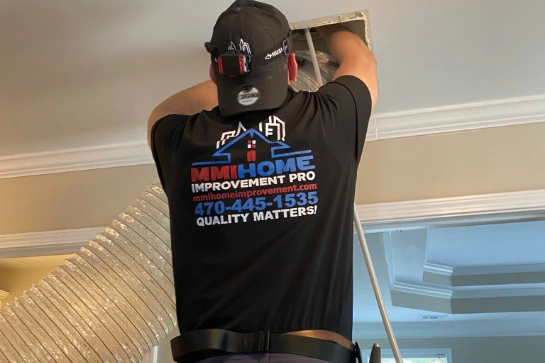
The tool then measures how much air the fan must push in to hold that pressure. Think of testing a bicycle tire underwater. A tight tire needs very little air. A leaky one keeps the pump working. The more air the fan needs, the leakier your ducts are.
Why Duct Leaks Matter More Than You Think
Joints loosen, tape dries out, and seams split over the years. Studies from the U.S. Department of Energy and ENERGY STAR suggest a typical home can lose roughly 20 to 30 percent of its conditioned air through leaky ducts. Leaks can cause:
- Higher energy bills
- Rooms that stay hot or cold
- A system that runs longer and wears out faster
- Dust and attic air pulled into your home
Read Also: What is a good source of UV Light at home?
How a Duct Blaster Test Works, Step by Step
Step 1: Seal the Vents and Registers
First, the technician covers every vent in your home with tape or thin plastic film. This includes the vents that blow air out and the ones that pull air back in. Once they are all covered, your duct system works like a big closed box.
Step 2: Connect the Duct Blaster Fan
Next, the technician hooks a special fan to your system. It usually goes on the main unit that moves your air, or on a main return vent. A small digital gauge is attached too. It shows how hard the air is pushing and how much air is moving.
Step 3: Pressurize the System
Now the fan turns on and fills the ducts with air, like blowing up a balloon. It builds pressure to a set level, usually 25 Pascals. Every duct blaster test uses this same level, so your results can be compared fairly with other homes.
Step 4: Record the Leakage
Then the technician reads the gauge. It shows how much air the fan must keep pushing to hold that pressure. If the ducts leak, the fan has to work harder. This number is called CFM25, which means cubic feet of air per minute. A bigger number means more leaks.
Step 5: Pinpoint the Leaks
Last, the technician looks for the exact spots where air is escaping. They may use a smoke pencil, which shows air moving, or a thermal camera, which shows hot and cold spots. This step turns the test into a repair plan, because now you know exactly what to fix.
How to Read Your Duct Blaster Test Results
There are two common readings:
- Total leakage: All air escaping from the duct system, anywhere.
- Leakage to outside: Air escaping outdoors, which wastes the most energy.
Results are often compared to your home’s size. Many energy codes and rebate programs set a limit near 4 CFM25 per 100 square feet of conditioned floor area, but requirements vary, so check your local code. A low number means tight ducts. A high number means leaks worth fixing.
When Should You Order a Duct Blaster Test?
Consider one if:
- Your energy bills keep rising for no clear reason
- Some rooms never feel comfortable
- You just built a home or finished a remodel
- You’re replacing your HVAC system
- A builder or rebate program requires it
How Long Does a Duct Blaster Test Take, and What Does It Cost?
Most tests take one to two hours for an average home. Larger homes or multi-unit systems take longer. Many homeowners see prices from about $150 to $500, though new-construction jobs can run higher. These are general estimates, so ask for a local quote.
What Happens If Your Ducts Fail the Test?
A high result is not a disaster. It is a to-do list. Common fixes include:
- Sealing joints and seams with mastic sealant (not cloth duct tape, which dries out)
- Reconnecting loose or fallen sections
- Insulating ducts in attics or crawl spaces
- Replacing badly damaged runs
How to Choose a Duct Blaster Test Provider
Ask whether the equipment is calibrated, whether you’ll get a written report with CFM25 numbers, whether they can fix the leaks they find, and whether they’ll retest after repairs. Be careful with anyone who says “pass” or “fail” without showing the numbers.
Summary
A duct blaster test turns a hidden problem into clear data. By sealing your vents, pressurizing the ducts, and reading the CFM25 number, a technician shows how much conditioned air you lose, where it escapes, and whether repairs are worth the cost. Most tests take one to two hours and cost roughly $150 to $500, a small price next to years of wasted energy.
The test is most useful when bills keep climbing, rooms feel uneven, or you are building, remodeling, or replacing your HVAC system. If your ducts fail, seal the leaks, reconnect loose sections, insulate exposed runs, or replace damaged ducts, then retest. The payoff is lower energy bills, better comfort, and less strain on your equipment.